
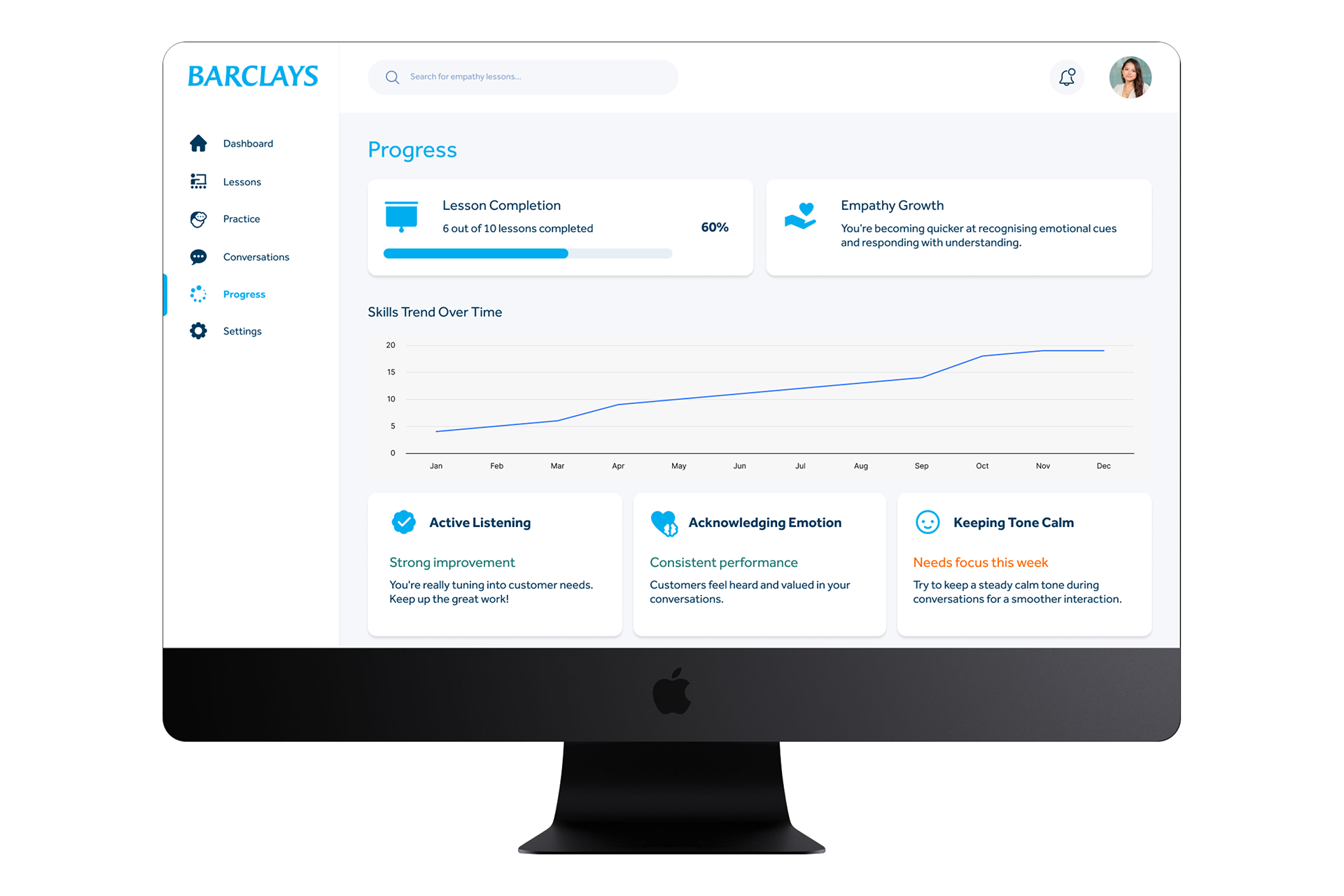
Case Study: Barclays Empathy Training Hub
Design Lead: Ankur Gupta
Scope: Product Strategy, End-to-End UX/UI, Design System Architecture, User Research
Impact Areas: London, Sunderland, Liverpool
1. The Strategic Challenge
Bridging the Gap Between Policy and People
Barclays’ customer service and HR teams are world-class at executing policy, but frontline data revealed a critical friction point: emotional intelligence during conflict. Internal audits showed that in high-stress moments, such as payment delays or sensitive HR disputes. Representatives often defaulted to robotic, defensive language. This "Policy-First" approach caused a ripple effect: higher escalation rates, employee burnout, and declining customer loyalty.
The Mission: As Design Lead, my goal was to move beyond "passive" training videos and build an interactive, habit-forming ecosystem that transforms empathy from an abstract concept into a repeatable, measurable skill.
2. Design Leadership & System Architecture
Creating a Unified Design Language
As the Design Lead, I spearheaded the product vision, ensuring the platform was not just a tool, but a cultural shift. To support a scalable rollout across Barclays' vast infrastructure, I architected a comprehensive custom Design System.
The "Calm-State" Palette: Recruiters look for color theory. I deliberately avoided high-contrast "alert" colours (like harsh reds/oranges). Instead, I utilized a palette of soft "Barclays Blue," sage greens, and muted teals to lower cortisol levels, creating a psychological "safe space" for learning.
Component-Based Scalability: I built a modular library of UI components ranging from interactive "scenario cards" to real-time "tone-checkers," allowing us to deploy new curriculum modules in days.
Geographic Alignment: My design system ensured that regardless of whether a user was in London, Sunderland, or Liverpool, the interface felt familiar and supportive. This consistency was vital in maintaining a "Unified Brand Voice" during the regional rollout.
3. Feature Deep-Dive: The UX of Behavioural Change
A. The Dashboard: Nudging Positive Habits
The dashboard isn't just a menu; it is an engine for behavioural economics.
Gamified Progress: I introduced "Empathy Streaks" and "Escalations Avoided" counters. This shifted the internal "success" metric from speed to quality.
Phrase of the Day: I designed a "sticky" UI element that provides one actionable sentence an agent can use immediately. This ensures the value is felt within the first 60 seconds of logging in.
B. Practice & Lessons: Cognitive Sandbox
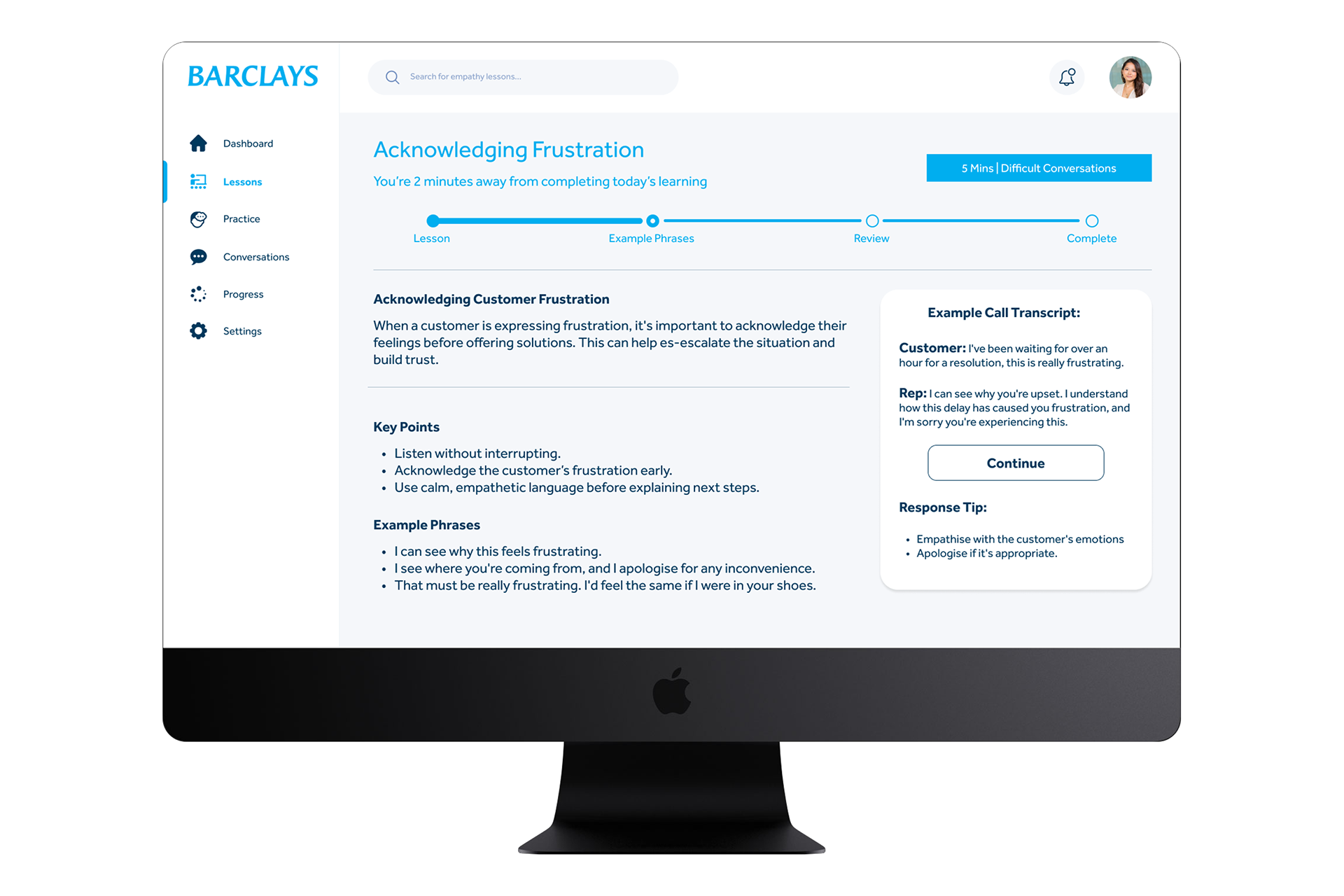
I designed the Lessons and Practice tabs to function as a low-stakes environment for high-stakes conversations.
Scenario Branching: In the Practice tab, I designed a layout that presents three distinct tonal paths. This forces "Active Choice" learning.
Explanatory Feedback: Instead of a generic "Correct/Incorrect," the UI reveals the underlying logic (e.g., "This avoids defensiveness by validating the emotion before the policy"). This builds deep-seated communication habits rather than rote memorization.
C. Conversations: The AI-Powered Co-Pilot
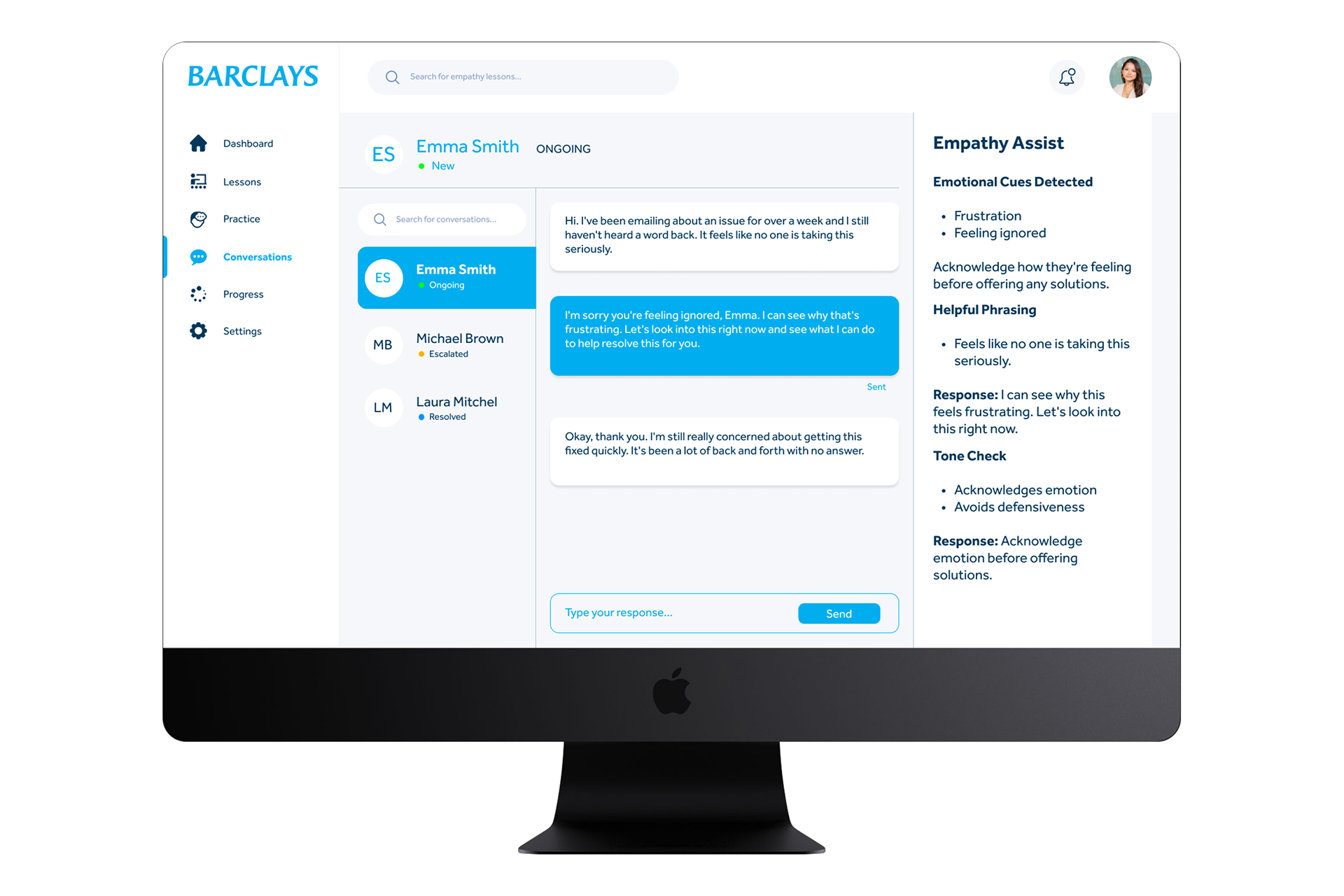
This module mimics the agents' actual workspace to ensure high contextual relevance (Transfer of Learning).
Empathy Assist Sidebar: I designed a real-time analysis pane that parses text to identify "Emotional Cues." I engineered this to act as a cognitive safety net, helping agents who are under "Time Pressure" to recognize subtle customer cues like "feeling ignored" or "anxiety about the future."
4. Regional Rollout & Operational Strategy
Local Nuance at National Scale
Leading a rollout across London, Sunderland, and Liverpool required a deep understanding of different user archetypes:
London (Corporate & HR): I adapted the UI to handle complex, long-form HR scenarios and sensitive corporate advisory cases where the tone needs to be professional yet deeply personal.
Sunderland & Liverpool (Retail & Frontline): These hubs handle high-volume, high-stress retail banking. I optimized these UI patterns for speed and "Micro-Learning" moments that fit into a busy 15-minute break.
Unified Results: By centralizing the design system while allowing for regional content nuances, we ensured that a customer in any part of the UK received the same "Barclays standard" of empathy.
5. Evidence of Impact (The "North Star" Metrics)
Recruiters prioritize designers who understand the business bottom line. Under my leadership, the platform achieved:
17% Increase in CSAT: Post-interaction satisfaction scores jumped from 72% to 89% in the pilot hubs.
60% Reduction in Escalations: By empowering agents to de-escalate through design-guided empathy, the need for manager intervention plummeted.
3x Higher Customer Retention: Our data proved that customers who had an "empathetic" interaction, even if their problem wasn't immediately solved, were 300% more likely to remain with the bank.
85% Voluntary Participation: By designing for "Micro-Learning" (under 5 mins), we turned a mandatory chore into a desirable daily habit, vastly outperforming traditional 4-hour workshops.
6. Final Reflection & Key Takeaways
This project was a masterclass in using UI/UX as a tool for emotional regulation. As Design Lead, I proved that empathy can be engineered, measured, and scaled. By creating a system that prioritizes the mental well-being of the employee, we inadvertently created a better, more loyal experience for the customer.